
The short version: somebody had to tool it
Why?
Good question. Obviously our goal is to make a profit without entirely losing our sense of humor. Hence, Rubber Ducky.
What we kept seeing
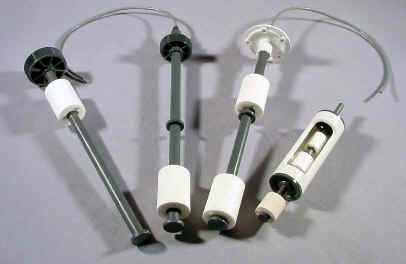
As mold makers and injection molders we have been involved with plastic for liquid level sensing for more than twenty years. In that time we watched our customers in this industry copy each other's products, build one and two cavity molds that were never production molds, and then complain about high mold costs and high part costs.
As the molder, we lived with the consequences: frequent insert changes, low production quantities, and low quality parts coming out of tooling that was never built to make them.
What we decided
We looked at the liquid level industry and concluded there are enough manufacturers offering essentially similar products that the total quantities justify a different approach. So we made the investment ourselves, in high quality, high cavitation molds, and we stock the parts they produce.
The idea is that you should be able to buy a float or a stem the way you buy nuts and bolts or electronic components: off the shelf, to a published specification, at a price that reflects real production volume.
For less than half of what you would pay for a temporary aluminum prototype mold, you get the quality and the cost savings of a class 101 multi cavity production tool.
What it costs to start
To buy plastic components from RDF we ask for a one time buy-in on each product. It is less than the cost of a single aluminum prototype insert. In exchange you get production parts at the piece pricing that only comes with higher cavitation, and you never carry the mold on your books.
Call us and we will walk you through the buy-in for the specific parts you need.
And the name?
We make floats. They float. Twenty years in industrial plastics has not yet cured us of finding that funny, and a part number is easier to remember when the company that supplies it is not called Precision Polymer Dynamics.
Tell us which part you keep re-tooling
There is a fair chance it is already in our catalog. If it is not, it may be the next one we tool.